How Much Does It Cost to Publish a Book in 2026? A Complete Cost Breakdown for Authors
One of the first questions aspiring authors ask is:
How much does it cost to publish a book?
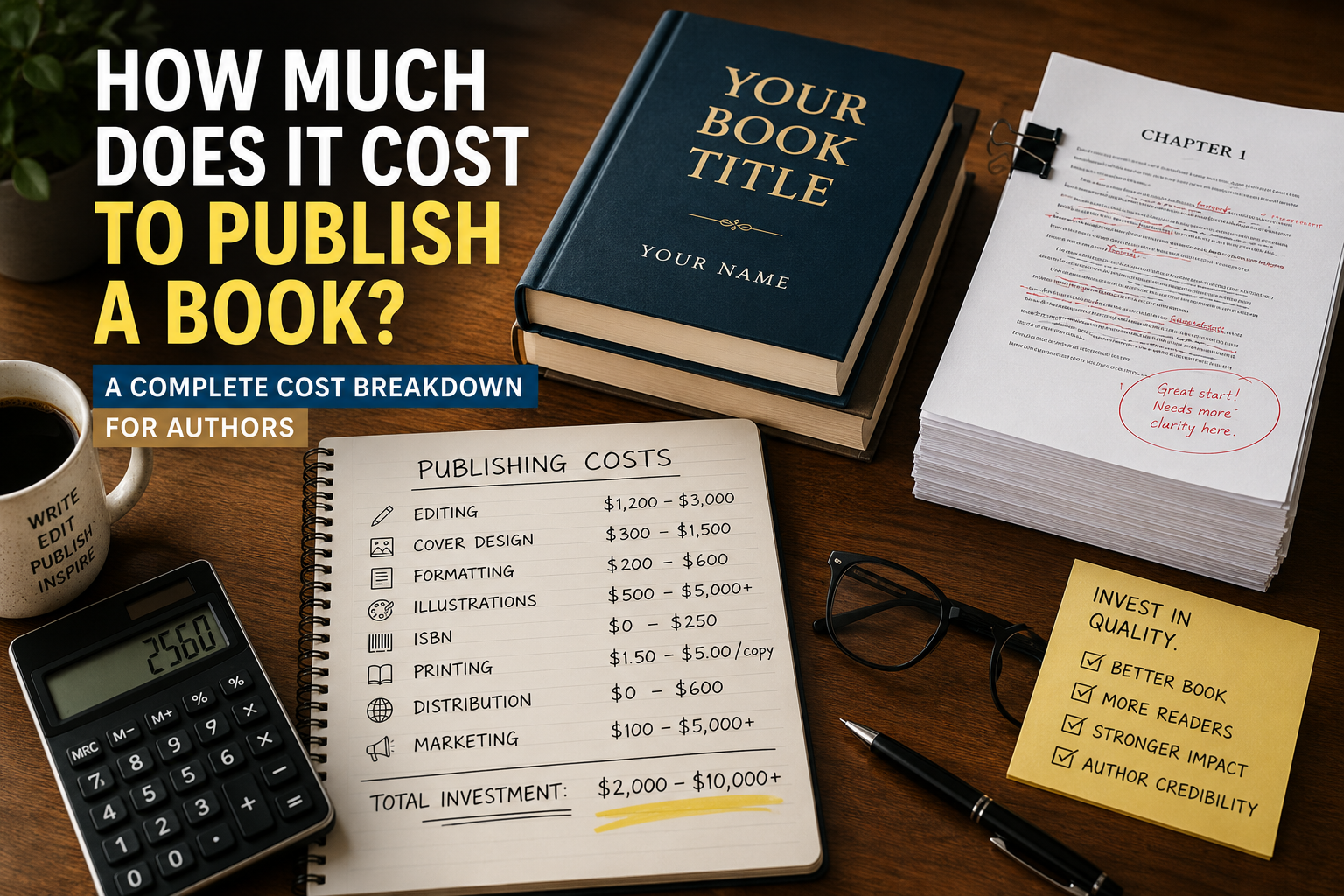
The honest answer is that publishing a book can cost almost nothing—or several thousand dollars—depending on the type of book, its current condition, the publishing route you choose, and the standard of quality you want to achieve.
An author can technically upload a manuscript to Amazon Kindle Direct Publishing without paying an upfront platform fee. Amazon currently allows authors to publish eBooks, paperbacks, and hardcovers through KDP for free. However, free uploading should not be confused with free professional publishing.
A book still needs to be prepared before it reaches readers.
That preparation may include:
Manuscript evaluation
Developmental editing
Copyediting
Proofreading
Book cover design
Interior formatting
Illustration
ISBN registration
Print preparation
Distribution setup
Marketing and launch support
The real cost of publishing is therefore not determined by the upload button. It is determined by how much professional work is required to turn the manuscript into a credible, readable, market-ready book.
This guide explains the major costs involved, where authors can save money, which services are worth prioritizing, and how to avoid spending heavily on services that do not meaningfully improve the book.
The Average Cost of Publishing a Book
A professionally produced self-published book commonly requires an investment of a few thousand dollars.
Reedsy’s 2026 publishing-cost analysis estimates that professional self-publishing can cost approximately $2,940 to $5,660, depending on the editorial work, design requirements, and other services involved. Other publishing providers place the typical professional range between roughly $1,000 and $5,000, although highly complex projects can cost considerably more.
These figures should be treated as broad market estimates rather than fixed prices.
A short poetry collection may require less editing and formatting than an 80,000-word business book.
A text-only memoir will usually cost less to produce than a fully illustrated children’s picture book.
A professionally designed nonfiction book with charts, tables, references, worksheets, and multiple formats may require a larger production budget than a straightforward novel.
The final cost depends on several variables:
The manuscript’s word count
The condition of the manuscript
The type and depth of editing required
The genre
The number of illustrations or visual elements
The number of formats being published
The distribution plan
The level of marketing support
Whether the author handles some tasks independently
Whether the project is managed by individual freelancers or a publishing service
Why Some Authors Publish for Almost Nothing
It is possible to publish a book with very little upfront expenditure.
An author may:
Edit the manuscript personally
Use free grammar-checking software
Design the cover with a template
Format the interior using free tools
Use a platform-provided ISBN
Upload the book directly to Amazon KDP
Promote the book through personal social-media accounts
Amazon KDP provides free publishing tools and offers free ISBNs for eligible paperback and hardcover editions. KDP also provides free guides and formatting resources for authors preparing their files.
This route may be suitable for an author who:
Has publishing or design experience
Is producing a private family book
Is testing an idea
Has a very limited budget
Is comfortable learning the technical process
Does not need the book to compete commercially
The limitation is that every task the author performs personally becomes dependent on their own skill level.
A free cover is not necessarily an effective cover.
A self-edited manuscript is not necessarily a professionally edited manuscript.
A file that uploads successfully is not necessarily formatted well.
The question is therefore not simply whether a book can be published cheaply. The more useful question is:
Will the final book represent the author and the content at the level required?
Publishing Cost by Publishing Route
Before calculating individual expenses, authors should understand the three main publishing paths.
1. Traditional Publishing
In traditional publishing, the publisher generally pays for editing, design, printing, distribution, and production.
The author does not usually pay the traditional publisher to release the book.
The process normally involves:
Completing or developing a strong manuscript
Preparing a proposal or query
Finding a literary agent, depending on the genre
Submitting to publishers
Securing a publishing contract
Working through the publisher’s editorial process
Traditional publishing can offer professional production, established distribution, industry relationships, and institutional credibility.
However, it is highly selective.
Authors may spend months or years submitting manuscripts. Even a strong book is not guaranteed to receive an offer. Publishers consider not only writing quality but also market conditions, author platform, sales potential, timing, genre demand, and the fit with their publishing list.
The author may also surrender some control over:
The title
Cover design
Editorial decisions
Publication timeline
Pricing
Distribution strategy
Marketing direction
Traditional publishing may cost little upfront, but the author pays in other forms: time, selectivity, reduced control, and a smaller share of each sale.
2. Independent or Self-Publishing
In self-publishing, the author takes responsibility for the publishing process.
The author may personally manage each stage or hire professionals for specific services.
This route offers greater control over:
Editorial decisions
Book design
Publication timing
Pricing
Rights
Royalties
Marketing strategy
Future revisions
The primary financial disadvantage is that the author funds the production.
Self-publishing costs vary widely because two authors may use the same publishing platform while producing books of very different quality.
One may upload an unedited Word document with a template cover.
Another may commission developmental editing, custom cover design, professional typesetting, print proofs, metadata optimization, and expanded distribution.
Both books are technically self-published, but they are not equivalent products.
3. Hybrid Publishing and Professional Publishing Services
Hybrid publishers and professional author-service companies occupy the space between traditional publishing and complete do-it-yourself publishing.
The author pays for professional assistance, while retaining more control than they typically would under a traditional publishing agreement.
Services may include:
Manuscript assessment
Editing
Proofreading
Cover design
Interior formatting
ISBN assistance
KDP setup
IngramSpark setup
Distribution guidance
Printing coordination
Author branding
Marketing support
The cost can range from a few thousand dollars to significantly more, depending on what is included.
Authors should evaluate these companies carefully.
Jane Friedman notes that paid publishing services can range from the low four figures to five figures or more, and that authors risk paying for unnecessary or overpriced services if they do not understand what a package actually includes.
A reputable provider should clearly explain:
Which services are included
Who owns the publishing rights
Who owns the final design files
Which platforms will be used
Whether the author retains control of platform accounts
Whether distribution is guaranteed or merely enabled
How royalties are handled
Whether marketing outcomes are promised
What happens after publication
Book Editing Costs
Editing is often the largest professional expense in the publishing process.
It is also one of the most important.
Editing prices depend on:
Word count
Genre
Manuscript quality
Type of editing
Editor experience
Turnaround time
Number of revision rounds
Not every manuscript requires the same form of editing.
Developmental Editing
Developmental editing examines the manuscript as a whole.
For fiction, the editor may evaluate:
Plot
Pacing
Character development
Conflict
Point of view
Narrative structure
Dialogue
Theme
Opening and ending
For nonfiction, the editor may assess:
Central argument
Chapter structure
Logic
Reader progression
Repetition
Evidence
Examples
Tone
Audience suitability
Practical usefulness
Developmental editing is usually more expensive than proofreading because it requires deep analysis and extensive editorial judgment.
The editor is not merely correcting sentences. They are helping shape the book.
A manuscript with strong ideas but weak organization may benefit more from developmental editing than from surface-level correction.
Line Editing
Line editing focuses on how the book communicates at the sentence and paragraph level.
A line editor may improve:
Clarity
Flow
Rhythm
Tone
Word choice
Transitions
Repetition
Emotional impact
Sentence construction
Consistency of voice
Line editing can be especially valuable for memoir, literary fiction, thought leadership, narrative nonfiction, and books in which the author’s voice is a central part of the reading experience.
Copyediting
Copyediting focuses on correctness and consistency.
It may address:
Grammar
Punctuation
Spelling
Syntax
Capitalization
Numbers
Dates
Hyphenation
Terminology
Style consistency
Basic factual inconsistencies
Copyediting is necessary even when the writing is strong.
Authors are often too familiar with their own work to notice every inconsistency or error.
Proofreading
Proofreading is the final editorial review.
It normally takes place after the manuscript has been edited and formatted.
The proofreader looks for remaining issues such as:
Typographical errors
Missing words
Incorrect punctuation
Spacing problems
Repeated words
Formatting inconsistencies
Incorrect headers
Page-number problems
Awkward line breaks
Errors introduced during layout
Proofreading is not a replacement for editing.
It is a final quality-control stage.
How Much Does Professional Editing Cost?
Editing costs are often calculated per word, per page, or per project.
For an 80,000-word manuscript, Reedsy’s 2026 estimates place professional editing between approximately $2,160 and $5,050, depending on whether the project requires basic copyediting, developmental work, or a more comprehensive editorial process.
Shorter manuscripts may cost less.
Longer, highly technical, poorly organized, or heavily researched manuscripts may cost more.
Children’s books may contain fewer words but still require specialized editorial judgment. Every line matters in a picture book, and the editor must consider language, reading level, pacing, page turns, illustration opportunities, and age suitability.
The cheapest editor is not always the most economical choice.
An inexpensive edit that fails to address structural problems may need to be repeated later.
Book Cover Design Costs
The cover is one of the most visible parts of a book.
It influences whether a potential reader:
Notices the book
Understands its genre
Reads the description
Clicks the product page
Takes the author seriously
Feels confident purchasing it
Cover-design prices vary based on:
Premade versus custom design
Designer experience
Genre
Illustration requirements
Image licensing
Typography complexity
Number of concepts
Revision rounds
Formats required
A professional designer must consider more than visual attractiveness.
The cover must work:
As a thumbnail
On retailer pages
In print
In advertising
On social media
Across paperback, hardcover, and eBook editions
Within the expectations of the genre
Reedsy’s analysis of more than 9,600 cover-design collaborations found an average professional cover-design cost of approximately $880, with many projects falling between $625 and $1,250. Genre and complexity can push the price higher or lower.
Premade covers are often less expensive because the basic concept already exists.
Custom illustrated covers generally cost more because they require original visual development.
Children’s books, fantasy novels, historical fiction, and detailed conceptual covers may require both an illustrator and a cover designer.
Interior Book Formatting Costs
Book formatting, also called typesetting or interior design, prepares the manuscript for publication.
Formatting determines how the book looks and functions on the page.
It includes decisions about:
Trim size
Margins
Fonts
Paragraph spacing
Chapter openings
Headers
Footers
Page numbers
Scene breaks
Table of contents
Footnotes
Images
Tables
Pull quotes
Indexes
References
Widows and orphans
Print specifications
A simple novel is generally easier to format than a workbook, textbook, cookbook, business book, or illustrated guide.
Formatting costs may range from a few hundred dollars for a straightforward text-based book to considerably more for a complex interior.
The author may need separate files for:
Paperback
Hardcover
Reflowable eBook
Fixed-layout eBook
Large-print edition
Audiobook companion material
Amazon offers free tools such as Kindle Create, and other platforms provide low-cost or free formatting options. These may work well for straightforward books.
However, professional typesetting becomes more valuable when the book contains complex material or when visual presentation is central to the reader experience.
Children’s Book Illustration Costs
Children’s books have a very different cost structure from text-only books.
Illustration may become the largest production expense.
The cost depends on:
Number of illustrations
Illustration style
Level of detail
Character complexity
Background complexity
Page size
Full-page versus spot illustrations
Cover illustration
Revision rounds
Commercial rights
Whether character development is included
Whether the illustrator also handles layout
A 24-page or 32-page picture book may require:
Character concept development
Storyboarding
Page-by-page sketches
Full-color illustrations
Cover artwork
Typography placement
Print-ready layout
Revision rounds
Authors should confirm whether the quoted price includes:
Commercial publishing rights
Source files
Front and back cover
Spine design
Title-page artwork
Endpapers
Formatting
Revisions
Promotional artwork
A low per-image price can become misleading if essential services are charged separately.
Consistency is especially important in children’s publishing. Characters, clothing, proportions, settings, and visual details should remain coherent from one scene to the next.
ISBN Costs
An ISBN is a unique identifier used for a specific book edition and format.
In the United States, Bowker is the official ISBN agency.
Separate ISBNs are generally used for different formats, such as:
Paperback
Hardcover
eBook
Large-print edition
Revised edition
Amazon KDP offers free ISBNs for paperback and hardcover books. However, authors may prefer to purchase their own ISBNs when they want greater control over the publishing imprint associated with the book.
Using a free KDP ISBN may be suitable for an author publishing primarily through Amazon.
Purchasing ISBNs may be more appropriate for authors who:
Want to use their own publishing imprint
Plan to distribute through multiple channels
Expect to publish several books
Want greater control over bibliographic records
Are building a long-term publishing brand
The ISBN itself does not market the book, guarantee bookstore placement, or create distribution demand.
It identifies the edition within the publishing supply chain.
Printing Costs
Print-on-demand technology allows authors to publish physical books without ordering thousands of copies in advance.
When a reader purchases the book, a copy can be printed and shipped.
The printing cost is normally deducted from the sale before the author’s royalty or publisher compensation is calculated.
Print cost depends on:
Page count
Trim size
Binding
Paper type
Black-and-white versus color interior
Hardcover versus paperback
Printing location
Quantity
Shipping
Bleed and production specifications
A black-and-white paperback novel is relatively inexpensive to print.
A full-color hardcover children’s book costs substantially more per copy.
This affects both the retail price and the author’s profit margin.
Authors should calculate printing economics before finalizing the book’s specifications.
A beautiful production choice may become commercially impractical if it forces the retail price far above comparable books.
Paperback, Hardcover, or eBook?
Each format creates additional production requirements.
eBook
An eBook eliminates physical printing costs, but the file still requires preparation.
The author may need:
eBook formatting
Image optimization
Linked table of contents
Device testing
Metadata
Cover resizing
A reflowable eBook allows text to adjust to different screens.
A fixed-layout eBook preserves the page design and is often used for children’s books, comics, art books, and image-heavy publications.
Paperback
Paperback is often the most accessible print format.
It is lighter, cheaper to produce, and easier to price competitively.
It is suitable for:
Novels
Memoirs
Business books
Self-help books
Poetry
Educational books
Workbooks
Hardcover
Hardcover books often feel more premium but cost more to print.
They may be appropriate for:
Gift books
Children’s books
Memoirs
Coffee-table books
Premium nonfiction
Collector editions
Institutional or professional titles
Publishing in all three formats increases the number of files, covers, ISBNs, proofs, and setup stages required.
Distribution Costs
Distribution makes a book available to retailers, libraries, wholesalers, and online platforms.
Amazon KDP provides access to Amazon’s marketplace and offers expanded options for some print books.
IngramSpark enables authors and publishers to manage print and eBook distribution through a broad wholesale network. It specializes in paperback, hardcover, eBook, print-on-demand, and global distribution.
Distribution should not be confused with sales.
Making a book available to order does not mean bookstores will automatically stock it.
Retailers consider factors such as:
Reader demand
Wholesale discount
Returnability
Local interest
Author platform
Sales history
Professional presentation
Marketing support
Genre
Bookstore fit
Authors should be cautious when a company promises guaranteed bookstore placement without clearly explaining the nature, scale, duration, and terms of that placement.
Book Marketing Costs
Publishing creates the product.
Marketing helps readers discover it.
Marketing expenses may include:
Author website
Landing page
Email marketing
Social-media content
Book trailer
Advertising
Public relations
Review copies
Influencer outreach
Launch events
Podcast appearances
Amazon advertising
Metadata optimization
Promotional graphics
Book-fair participation
Some authors spend very little and rely on organic outreach.
Others invest thousands of dollars in launches, ads, public relations, events, and ongoing campaigns.
A large marketing budget does not guarantee sales.
Marketing works best when the book already has:
A defined audience
Strong positioning
A professional cover
A persuasive description
Credible reviews
Competitive pricing
Effective sample pages
A clear reason for readers to care
Advertising cannot permanently compensate for a weak publishing foundation.
It can increase visibility, but visibility only helps when the book converts interest into purchases.
Hidden Publishing Costs Authors Often Miss
Many publishing budgets focus only on editing and cover design.
Several additional expenses may appear later.
1. Revision After Editing
Developmental editing may lead to substantial rewriting.
The author may then need another editorial review or a final copyedit.
2. Additional Cover Formats
A paperback cover cannot always be reused unchanged for hardcover.
Each format may require different dimensions, spine width, templates, or production files.
3. Proof Copies
Authors should order physical proofs before approving publication.
More than one proof may be required if corrections are made.
4. Author Copies and Shipping
Bulk author copies can be useful for events, direct sales, reviewers, libraries, and promotions.
Printing and shipping costs should be included in the launch budget.
5. Corrections After Publication
Minor corrections may require revised files.
Some platforms or service providers may charge for file updates, especially if new formatting or cover work is needed.
6. Website and Branding
Authors planning a long-term career may need:
A professional website
Author photography
Email hosting
Domain registration
Branding
Media materials
Newsletter software
7. Permissions
Using song lyrics, extensive quotations, photography, artwork, or copyrighted material may require permission and licensing fees.
8. Indexing
Academic, historical, technical, and reference books may benefit from a professional index.
Indexing is a specialist service and may represent a separate expense.
9. Audiobook Production
Audiobook narration, editing, mastering, quality control, and distribution create an entirely separate production budget.
What Should Authors Spend Money On First?
When the budget is limited, prioritize the elements that most directly affect reader trust and usability.
A sensible order is:
1. Manuscript Quality
The book must work before it is decorated.
Invest first in the level of editing the manuscript genuinely requires.
2. Proofreading
Visible errors weaken credibility and can lead to negative reviews.
3. Cover Design
The cover determines whether many readers will investigate the book at all.
4. Interior Formatting
The reading experience should feel professional and comfortable.
5. Metadata and Distribution Setup
The book needs accurate title information, description, categories, keywords, pricing, and platform setup.
6. Marketing
Promote the book after the product, positioning, and sales page are ready.
Where Can Authors Save Money?
Publishing economically does not necessarily mean sacrificing every professional standard.
Authors can reduce costs by:
Revising thoroughly before hiring an editor
Using beta readers before professional editing
Providing a clean, organized manuscript
Choosing standard trim sizes
Limiting unnecessary color pages
Using a premade cover when appropriate
Publishing fewer formats initially
Learning basic platform management
Preparing marketing content in advance
Purchasing only services relevant to the book
Comparing detailed proposals rather than package names
Requesting clarity about revisions and deliverables
One of the best ways to control cost is to begin with a realistic publishing plan.
Expensive problems often arise when authors make decisions in the wrong order.
For example:
Designing the cover before finalizing the title
Formatting before editing is complete
Buying an ISBN before choosing the imprint strategy
Printing copies before reviewing a physical proof
Running ads before improving the book description
Hiring a marketer before defining the audience
Correct sequencing prevents duplicated work.
Questions to Ask Before Hiring a Publishing Company
Before paying for publishing services, ask:
What exactly is included in the price?
What type of editing will be performed?
How many revision rounds are included?
Who owns the publishing rights?
Who owns the final cover and interior files?
Will I control my Amazon and distribution accounts?
Which formats are included?
Is the ISBN included, and whose imprint will appear?
Is the cover custom or template-based?
Are print proofs included?
Is distribution setup included?
Does “distribution” mean availability or bookstore placement?
How will royalties be paid?
Are there recurring fees?
What happens if I want to update the book?
Are marketing results guaranteed?
Can I review samples of comparable books?
Is there a written contract and delivery schedule?
A trustworthy publishing company should answer these questions clearly.
Unclear language is a warning sign.
Common Publishing Scams and Red Flags
Authors are emotionally invested in their work, which can make them vulnerable to aggressive sales tactics.
Be cautious when a company:
Guarantees bestseller status
Guarantees a film or television deal
Claims a major publisher has already selected the book
Demands immediate payment
Refuses to provide a written scope of work
Hides the ownership terms
Promises bookstore placement without specifics
Charges repeatedly for unexpected upgrades
Contacts the author using excessive flattery
Claims Amazon requires payment through a third party
Requests Amazon passwords or banking credentials
Offers fake reviews
Uses pressure rather than transparent consultation
Amazon states that KDP is a free service and is not affiliated with third-party publishing companies. It also warns authors not to share sensitive account information outside their KDP account.
A legitimate service provider may charge for editing, design, account setup assistance, consultation, or project management.
They should not falsely represent those fees as mandatory Amazon publishing charges.
Is Professional Publishing Worth the Cost?
Professional publishing is worthwhile when the quality of the book matters to the author’s larger goals.
A book may support:
A writing career
A speaking career
A consulting business
A professional reputation
A personal brand
A nonprofit mission
A family legacy
An educational program
A coaching framework
A healthcare practice
A law or financial practice
A corporate training system
In these cases, the book is more than a product.
It is a representation of the author’s ideas, expertise, standards, and credibility.
A poorly produced book may cost less initially but weaken the opportunity the book was intended to create.
Professional publishing does not guarantee commercial success.
It does ensure that the book receives a fairer opportunity to be taken seriously.
A Sample Publishing Budget
A realistic professional publishing budget for a standard text-based book might include:
Manuscript assessment
Developmental or copyediting
Proofreading
Custom cover design
Paperback formatting
eBook formatting
ISBN support
Platform setup
Print proof review
Basic launch materials
A children’s book budget may include:
Manuscript editing
Character design
Storyboarding
Full-color illustrations
Cover design
Page layout
Print formatting
eBook preparation
Proof review
Distribution setup
The correct budget is not the largest one.
It is the budget that matches:
The needs of the manuscript
The expectations of the audience
The author’s goals
The competitive standard of the genre
The intended distribution
The author’s financial capacity
Frequently Asked Questions
Can I publish a book for free?
Yes. Platforms such as Amazon KDP allow authors to upload and publish eligible eBooks, paperbacks, and hardcovers without an upfront publishing fee.
However, professional editing, custom cover design, formatting, illustration, marketing, and other services may still cost money.
How much does it cost to self-publish a book?
A professionally produced self-published book frequently costs a few thousand dollars, although the amount can be lower or higher depending on word count, editing, design, format, illustration, and marketing requirements. Industry estimates commonly place professional projects between approximately $2,000 and $6,000, with complex books costing more.
What is the most expensive part of publishing?
For text-based books, editing is often the largest expense.
For children’s books, illustration may be the largest expense.
For image-heavy, academic, technical, or highly designed books, interior production may also represent a substantial cost.
Does Amazon charge to publish a book?
Amazon KDP does not charge an upfront fee to publish eligible eBooks, paperbacks, and hardcovers. Printing costs are generally deducted from print-book sales before royalties are calculated.
Do I need an ISBN?
Paperback and hardcover editions generally need an ISBN for standard retail identification.
KDP can provide a free ISBN for eligible print editions, or an author can purchase an ISBN from the official agency in their country. In the United States, the official agency is Bowker.
Should I pay a publisher to publish my book?
Traditional publishers generally do not charge authors to publish.
Professional publishing-service companies and hybrid publishers may charge because the author is purchasing editing, design, production, distribution assistance, or project management.
The decision should depend on the contract, service quality, ownership terms, price, and the author’s goals.
How long does it take to publish a book?
A straightforward book may be prepared within a few months.
A manuscript requiring extensive rewriting, illustration, multiple editing rounds, or complex design may take longer.
Once files are submitted, Amazon states that many books can take up to three business days to become live, although low-content books may take longer. That platform-processing period comes after the much longer editorial and production process.
Is it better to self-publish or use a publishing company?
Self-publishing independently may suit authors who have the time, technical confidence, and professional contacts to manage the process.
A publishing company may suit authors who want coordinated support with editing, design, formatting, distribution, and production.
The better route is the one that offers the right balance of control, quality, cost, speed, and professional support.
Final Thoughts
The cost of publishing a book cannot be reduced to one universal number.
Technically, a book can be uploaded for free.
Professionally, a book requires a series of careful decisions and specialized services.
The most important question is not:
What is the cheapest way to publish my book?
It is:
What level of investment will allow this book to achieve the purpose for which I wrote it?
A personal book intended for family members may require a modest production process.
A business book designed to establish authority may require stronger editing, design, and distribution.
A children’s picture book may require a significant illustration budget.
A novel intended to compete commercially must meet the expectations of readers already familiar with professionally published fiction.
Good publishing is not about purchasing every available service.
It is about identifying what the manuscript needs, completing each stage in the correct order, and ensuring the final book reflects the value of the ideas inside it.
At Global Publishers House, we help authors move from manuscript to professionally prepared book through editing, proofreading, cover design, interior formatting, publishing setup, and distribution guidance.
Every project begins with the manuscript, the author’s goals, and a clear understanding of what the book actually needs.
Because publishing should not feel like paying for a collection of disconnected services.
It should feel like building one complete, credible book.
Related on Global Publishers House
- Learn more about our book publishing services.
- Ready when you are — submit your manuscript for a free publishing plan.