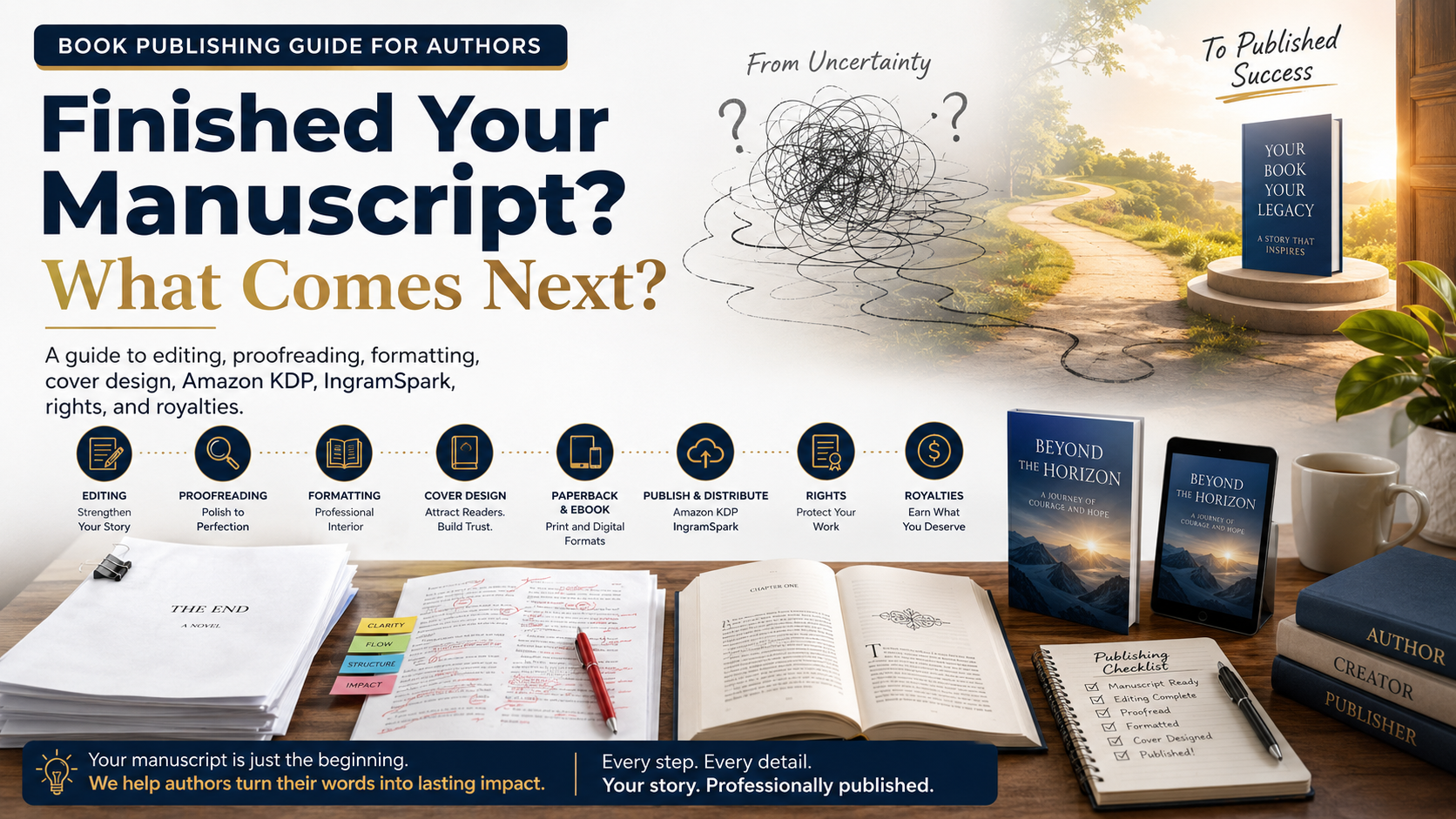
Finishing your manuscript is a major achievement.
For weeks, months, or even years, your book lived in your mind before it became a real draft. You may have written early in the morning, late at night, between work, after family responsibilities, or during quiet moments when the idea would not leave you alone.
Now the manuscript is complete.
But instead of feeling only relief, many authors feel a new kind of confusion.
What happens next?
Do you need an editor?
Should you proofread first?
How do you format the book?
Can you publish it on Amazon?
Do you need IngramSpark?
Who designs the cover?
Do you keep your rights?
Where do royalties go?
How do you make sure the book looks professional instead of self-made?
This stage can feel overwhelming because writing a manuscript and publishing a book are not the same thing.
A manuscript is the raw material. A published book is a finished product that has been edited, proofread, designed, formatted, prepared, uploaded, and positioned for readers.
The good news is that you do not need to figure everything out at once.
This guide walks you through the professional next steps after finishing your manuscript, so you can move forward with clarity and avoid the mistakes that often hold first-time authors back.
First, Understand This: A Finished Manuscript Is Not Always A Finished Book
Many new authors believe that once the writing is complete, the book is ready to publish.
That is understandable.
Writing is the hardest emotional part of the process. You have already done the thinking, the storytelling, the research, the outlining, the rewriting, and the discipline required to reach the final page.
But from a publishing perspective, finishing the manuscript is the beginning of a new stage.
Your manuscript still needs to become a reader-ready book.
That means it may need:
· Professional editing
· Proofreading
· Interior formatting
· Cover design
· Book description
· Metadata
· Publishing platform setup
· ISBN decisions
· Paperback and ebook preparation
· Upload support
· Distribution planning
· Launch preparation
This is where many authors get stuck.
They do not get stuck because their book is bad. They get stuck because publishing brings dozens of small decisions they were never prepared for.
The purpose of this guide is to help you understand those decisions before you rush into publishing.
Step 1: Take A Short Break Before You Edit Or Publish
After finishing your manuscript, your first instinct may be to send it out, upload it, or start asking people to read it immediately.
Before you do that, pause.
Give yourself a short break from the manuscript.
This does not mean abandoning the book. It means giving your mind enough distance to see the work more clearly.
When you have been writing the same book for months, your brain starts filling in gaps automatically. You may not notice repeated ideas, awkward transitions, missing context, weak chapter openings, timeline issues, grammar problems, or sections that make sense to you but may confuse a new reader.
A short break helps you return with fresher eyes.
For some authors, a few days is enough. For others, two weeks may be better. The goal is not to delay the book forever. The goal is to stop yourself from publishing while you are still too close to the draft.
When you return, read the manuscript as if you are not the author.
Ask yourself:
· Does the book open strongly?
· Is the message clear?
· Are there sections that drag?
· Does each chapter have a purpose?
· Are there repeated ideas?
· Would a reader understand what I am trying to say?
· Does the ending feel complete?
· Does this feel like a book or still like a draft?
This first review will not replace professional editing, but it will help you understand where the manuscript currently stands.
Step 2: Decide Which Publishing Path Makes Sense For You
Once your manuscript is complete, you need to choose the publishing path that matches your goals.
Most authors consider three main options: traditional publishing, self-publishing, or assisted publishing.
Traditional Publishing
Traditional publishing usually means submitting your manuscript to literary agents or publishers. If your book is accepted, the publisher may handle editing, design, production, distribution, and part of the marketing process.
The benefit is industry credibility and professional backing.
The challenge is that traditional publishing can be very competitive and slow. Many authors wait months for responses. Some never receive an acceptance. Even when accepted, the publishing timeline can take a long time.
Traditional publishing may make sense if you are willing to wait, submit repeatedly, and give up some control in exchange for a chance at a traditional deal.
Self-Publishing
Self-publishing gives you more control.
You can publish through platforms like Amazon KDP and IngramSpark without waiting for a traditional publisher to approve your book.
The benefit is control, speed, and ownership.
The challenge is that you are responsible for the full publishing process. That includes editing, proofreading, formatting, cover design, upload, pricing, metadata, categories, keywords, and distribution choices.
Self-publishing can work very well when the book is professionally prepared. But if the book is rushed, poorly formatted, weakly edited, or badly designed, it can look unprofessional quickly.
Assisted Publishing
Assisted publishing is when an author works with a publishing support company to prepare and publish the book professionally while still keeping more control than they would in a traditional publishing arrangement.
This can include services such as manuscript review, editing, proofreading, formatting, cover design, Amazon KDP setup, IngramSpark support, and publishing guidance.
This path is often useful for authors who do not want to wait for a traditional publisher but also do not want to manage the technical publishing process alone.
At Global Publishers House, this is the kind of author we often support: someone who has a manuscript and wants help turning it into a professionally prepared book.
Step 3: Know What Your Manuscript Actually Needs
Before paying for editing, formatting, or publishing help, you need to understand the condition of your manuscript.
Not every manuscript needs the same service.
Some manuscripts need deep structural editing. Some need sentence-level polishing. Some are almost ready and only need proofreading. Some are written well but need formatting and publishing setup.
The worst mistake is buying the wrong service because you are not sure what stage your book is in.
Here are the main levels of manuscript support.
Developmental Editing
Developmental editing looks at the big picture of the book.
For fiction, this may include plot, pacing, character development, structure, scenes, conflict, dialogue, and emotional flow.
For nonfiction, this may include organization, argument, clarity, chapter order, reader journey, examples, logic, and overall message.
Developmental editing is helpful when the book has strong potential but still needs deeper shaping.
Line Editing
Line editing focuses on how the writing flows from sentence to sentence.
It improves clarity, tone, rhythm, readability, and expression.
This type of editing helps your writing sound smoother and more professional without changing the core idea of the book.
Copyediting
Copyediting focuses on grammar, punctuation, consistency, spelling, sentence structure, and correctness.
It helps remove errors and makes the manuscript cleaner.
This is important before formatting because once a book is formatted, major text changes can disrupt the layout.
Proofreading
Proofreading is the final check before publication.
It catches typos, small errors, punctuation issues, spacing problems, and final mistakes.
Proofreading should usually happen after editing and formatting, not before everything else.
Manuscript Review
A manuscript review helps identify what the book needs before you commit to a full publishing plan.
This is often a smart first step for authors who are unsure whether their book needs editing, proofreading, formatting, or deeper work.
If you are not sure what your manuscript needs, you can start by submitting it for review instead of guessing.
Step 4: Do Not Skip Professional Editing
Editing is one of the most important steps in the publishing process.
A good editor does more than fix grammar. Editing helps protect the reader’s experience.
Readers may forgive a few small mistakes, but they quickly lose trust if a book feels unclear, repetitive, rushed, or poorly organized.
Professional editing can help with:
· Clarity
· Structure
· Readability
· Flow
· Grammar
· Tone
· Consistency
· Repetition
· Chapter transitions
· Sentence strength
· Reader engagement
Many authors are afraid editing will change their voice. Good editing should not erase your voice. It should help your voice come through more clearly.
The goal is not to make your book sound like someone else wrote it.
The goal is to make your book sound like the strongest version of itself.
If your manuscript is very personal, such as a memoir, spiritual book, self-help book, or life story, editing becomes even more important because the message needs to feel clear, emotionally honest, and easy for readers to follow.
Step 5: Prepare The Book For Readers, Not Just For Upload
A manuscript is usually written in a document file.
A book needs to be designed for reading.
That is where formatting comes in.
Book formatting controls how the interior of your book appears on the page or screen. It affects margins, spacing, chapter titles, page numbers, headers, table of contents, title page, copyright page, section breaks, and overall readability.
For print books, formatting needs to match the correct trim size. Common sizes include 5.5 x 8.5, 6 x 9, and other formats depending on the genre.
For ebooks, formatting needs to work across Kindle devices, tablets, phones, and reading apps.
Poor formatting can make a book look amateur even if the writing is good.
Common formatting problems include:
· Strange spacing
· Broken chapter headings
· Incorrect margins
· Missing page numbers
· Unbalanced pages
· Poor table of contents
· Images not aligned correctly
· Ebook text not flowing properly
· Title page or copyright page appearing incorrectly
· Print layout not matching platform requirements
This is especially important for children’s books, poetry, workbooks, journals, nonfiction books with sections, and books that include images or special design elements.
If you want the book to feel professional, formatting cannot be an afterthought.
Step 6: Design A Cover That Matches The Reader’s Expectations
Your cover is not just decoration.
It is one of the first trust signals your book gives to a potential reader.
Before someone reads your description, checks your reviews, or opens the first page, they see the cover.
A professional cover should communicate the right genre, tone, audience, and quality level.
For example:
· A children’s book should feel warm, visual, age-appropriate, and engaging.
· A business book should feel clear, confident, and credible.
· A memoir should feel emotional, personal, and aligned with the story.
· A self-help book should feel trustworthy, useful, and approachable.
· A fantasy or fiction book should match the expectations of that genre.
One common mistake is designing a cover based only on personal taste.
The better question is not only, “Do I like this cover?”
The better question is, “Would my target reader understand this book from the cover?”
A strong cover helps your book look like it belongs in the market. A weak cover can make readers hesitate, even if the content is valuable.
Step 7: Understand Amazon KDP And IngramSpark Before Publishing
Many authors hear about Amazon KDP first.
Amazon KDP allows authors to publish ebooks and paperbacks on Amazon. It is one of the most common self-publishing platforms because Amazon is where many readers already search for books.
KDP can be a strong option if you want your book available on Amazon quickly.
But KDP is not the only platform.
IngramSpark is often used for wider print distribution. It can help make a book available to bookstores, libraries, and retailers through Ingram’s distribution network.
Some authors use only Amazon KDP. Some use both KDP and IngramSpark.
The right choice depends on your goals.
If your main goal is to sell on Amazon, KDP may be the priority. If you want broader distribution possibilities, IngramSpark may also be worth considering.
Before publishing, you need to prepare:
· Final manuscript file
· Print-ready interior file
· Ebook file
· Front cover
· Full paperback cover
· Book title
· Subtitle
· Author name
· Book description
· Categories
· Keywords
· Pricing
· Trim size
· ISBN decision
· Rights and territory settings
This is where publishing becomes technical.
Even a strong book can run into problems if the files are not prepared correctly.
Step 8: Understand Rights, Royalties, And Control
Before you publish, you should clearly understand who controls the book.
This is one of the biggest concerns authors have, and it is a valid concern.
You should know:
· Do you keep ownership of your manuscript?
· Who controls the publishing account?
· Where do royalties go?
· Who owns the final files?
· Can you make changes after publishing?
· Are you locked into a long contract?
· Are there hidden fees?
· Will the book be published under your author name?
· Can you publish future editions?
· Can you use the book for speaking, coaching, teaching, or business purposes?
A professional publishing process should be transparent.
If you are working with a publishing service, do not be afraid to ask direct questions.
You should understand what you are paying for, what you keep, what the company handles, and what happens after the book goes live.
At Global Publishers House, we believe authors should understand the publishing process before they commit to it. Confusion is not a good foundation for publishing.
Step 9: Prepare Your Book Description And Metadata
Many authors spend months writing the book but only a few minutes writing the description.
That is a mistake.
Your book description is one of the most important sales elements on your Amazon or retailer page.
It should explain:
· Who the book is for
· What problem it solves
· What experience it offers
· Why the reader should care
· What makes the book worth reading
Metadata also matters.
Metadata includes things like:
· Title
· Subtitle
· Keywords
· Categories
· Author name
· Description
· Contributor details
· Age range, if relevant
· Genre
· BISAC/category choices
This information helps platforms understand where your book belongs.
For example, if your book is a children’s book, it should be positioned differently from a memoir, business book, devotional, or self-help guide.
A good publishing plan does not only prepare the book file. It also prepares the book listing.
Step 10: Create A Simple Publishing Timeline
Publishing becomes less overwhelming when you break it into stages.
Here is a simple example timeline:
Stage 1: Manuscript Review
Review the manuscript and decide what level of editing or support it needs.
Stage 2: Editing
Improve the structure, clarity, grammar, flow, and readability.
Stage 3: Proofreading
Catch final typos, punctuation issues, and small errors.
Stage 4: Formatting
Prepare the book interior for paperback, ebook, hardcover, or other formats.
Stage 5: Cover Design
Create the front cover and full print cover according to platform requirements.
Stage 6: Publishing Setup
Prepare Amazon KDP, IngramSpark, metadata, categories, pricing, and files.
Stage 7: Final Review
Check the preview files and make sure the book looks correct before approval.
Stage 8: Publication
Publish the book and confirm that the live listing looks professional.
Your timeline will depend on the length of the book, the condition of the manuscript, the type of book, and the number of services needed.
A short poetry book may move faster than a long memoir. A children’s book with illustrations may need more design coordination. A complex nonfiction book may need deeper editing and formatting.
The point is not to rush.
The point is to move in the right order.
How Do You Know If Your Manuscript Is Ready To Publish?
Your manuscript may be ready for publishing preparation if:
· The main content is complete
· The chapters are in the correct order
· The message or story is clear
· The book has a beginning, middle, and end
· You are not planning major rewrites
· You know who the book is for
· You are ready for professional editing or proofreading
· You want the book prepared for readers
Your manuscript may not be ready yet if:
· You still have missing chapters
· You are unsure about the structure
· The story or message feels incomplete
· You know major sections need rewriting
· You have not decided the book’s audience
· You are not ready for someone else to review it
· You are still changing the core idea of the book
If you are somewhere in the middle, a manuscript review can help you decide the next step.
You do not have to know everything before asking for help. You only need to know that you are ready to move forward.
Common Mistakes Authors Make After Finishing A Manuscript
Many publishing problems happen because authors rush the steps after writing.
Here are the mistakes to avoid.
Mistake 1: Publishing Too Quickly
Finishing the manuscript feels exciting, but rushing to publish can lead to avoidable errors.
Take time to review, edit, format, and prepare the book properly.
Mistake 2: Skipping Editing
Even talented writers need editing.
A second professional eye can catch things you may miss because you are too close to the manuscript.
Mistake 3: Confusing Proofreading With Editing
Proofreading catches final mistakes. Editing improves the manuscript at a deeper level.
If your book needs structure, clarity, flow, or readability work, proofreading alone will not be enough.
Mistake 4: Using A Weak Cover
A weak cover can make readers judge the book before they ever read a page.
Your cover should match your genre and reader expectations.
Mistake 5: Formatting The Book Like A Document
A Word document is not the same as a professionally formatted book.
Formatting affects how the book feels in print and digital formats.
Mistake 6: Not Understanding Rights And Royalties
Before publishing, make sure you know who owns the book, who receives royalties, and who controls the publishing account.
Mistake 7: Ignoring The Book Listing
The book description, categories, keywords, and pricing all affect how readers understand your book.
Do not treat them as last-minute details.
Mistake 8: Thinking Publishing And Marketing Are The Same
Publishing makes the book available. Marketing helps people discover it.
Both matter, but they are different stages.
Final Checklist Before Publishing Your Book
Before your book goes live, make sure you can answer these questions:
· Has the manuscript been professionally reviewed?
· Does the book need editing, proofreading, or both?
· Has the manuscript been finalized before formatting?
· Is the book formatted for paperback, ebook, or hardcover?
· Is the cover designed for the correct genre?
· Is the full paperback cover prepared correctly?
· Have you chosen Amazon KDP, IngramSpark, or both?
· Is your book description ready?
· Have you selected categories and keywords?
· Do you understand your rights and royalties?
· Do you know where your royalties will be paid?
· Do you know who controls the publishing account?
· Have you checked the final preview before publishing?
· Do you have a simple plan for what happens after launch?
If you cannot answer several of these questions, it may be too early to publish.
That does not mean your book is not good.
It simply means the publishing plan needs more clarity.
When Should You Ask For Professional Publishing Help?
You may need professional publishing help if:
· You have finished your manuscript but feel unsure what to do next
· You do not know whether your book needs editing or proofreading
· You want your book published on Amazon KDP
· You want help with IngramSpark setup
· You need paperback or ebook formatting
· You need a professional book cover
· You are confused about publishing files and platform requirements
· You want to avoid mistakes that make the book look unprofessional
· You want someone to guide you through the process
Professional support is not only for authors who cannot do things themselves.
It is also for authors who want the book handled properly.
Your manuscript represents a serious investment of time, thought, and effort. The publishing stage should respect that.
How Global Publishers House Helps Authors After The Manuscript Is Finished
Global Publishers House helps authors move from finished manuscript to professionally prepared book.
Depending on your book’s needs, this may include:
· Manuscript review
· Editing
· Proofreading
· Book formatting
· Cover design
· Amazon KDP support
· IngramSpark support
· Publishing guidance
· Paperback and ebook preparation
· Distribution guidance
· Author support through the publishing process
The goal is not to make publishing more confusing.
The goal is to give you a clear path.
If you already have a manuscript and are not sure what the next step should be, you can submit your manuscript to Global Publishers House for review.
From there, you can understand what your book needs before it is published.
Frequently Asked Questions
What should I do first after finishing my manuscript?
The first step is to take a short break, then review the manuscript with fresh eyes. After that, you should decide whether the book needs editing, proofreading, formatting, cover design, or publishing support.
If you are unsure, a manuscript review can help identify the right next step.
Should I edit my book before publishing?
Yes, most manuscripts should be edited before publishing.
Editing improves clarity, structure, grammar, flow, and readability. Even if your ideas are strong, editing helps make the book easier and more enjoyable for readers.
Is proofreading enough before publishing?
Proofreading is only enough if the manuscript is already polished.
If the book has issues with structure, clarity, repetition, grammar, or flow, it likely needs editing before proofreading.
Proofreading should usually be the final check before publication.
Can I publish my book without a traditional publisher?
Yes. Many authors publish through self-publishing platforms such as Amazon KDP and IngramSpark.
However, self-publishing still requires professional preparation if you want the book to look polished. Editing, formatting, cover design, metadata, and platform setup all matter.
Should I use Amazon KDP or IngramSpark?
Amazon KDP is commonly used for publishing ebooks and paperbacks on Amazon. IngramSpark is often used for wider print distribution.
Some authors use one platform. Some use both. The best option depends on your publishing goals.
Do I keep the rights to my book when I self-publish?
In most self-publishing situations, authors keep their rights. However, you should always understand the terms of any publishing service or platform you use.
Before working with any company, ask who owns the files, who controls the publishing account, and where royalties are paid.
How long does it take to publish a book after the manuscript is finished?
The timeline depends on the manuscript length, editing needs, formatting, cover design, and publishing setup.
A simple book may move faster. A longer or more complex book may take more time. The most important thing is to follow the right order rather than rushing to publish before the book is ready.
Do I need a professional book cover?
Yes, if you want the book to look credible.
The cover is one of the first things readers judge. A professional cover should match the genre, audience, and tone of the book.
Can Global Publishers House help me publish my book?
Yes. Global Publishers House helps authors prepare and publish their books professionally through services such as editing, proofreading, formatting, cover design, Amazon KDP support, IngramSpark support, and publishing guidance.
If your manuscript is complete, you can submit it for review and take the next step toward publication.
Final Thoughts: Your Manuscript Deserves A Professional Next Step
Finishing your manuscript is not a small thing.
It means you carried an idea far enough to turn it into a complete draft. Many people talk about writing a book. Far fewer actually finish one.
But now the book needs its next stage.
It needs to be reviewed, edited, proofread, formatted, designed, prepared, and published in a way that respects the work you have already done.
Do not rush the process just because the manuscript is finished.
And do not let the process become so confusing that the book stays stuck on your laptop for another year.
Your manuscript deserves a clear publishing path.
If you are ready to turn your finished manuscript into a professionally prepared book, Global Publishers House can help you understand what comes next and guide you through the publishing process.
Submit your manuscript today and take the next step toward becoming a published author.
Related on Global Publishers House
- Learn more about our book publishing services.
- Ready when you are — submit your manuscript for a free publishing plan.